-
Trimmsolutions
- September 21, 2026
The Dangote Petroleum Refinery IPO has done more than attract retail investors to Africa’s largest-ever share sale. It has provided a live stress test of Nigeria’s digital financial infrastructure, and a useful management lesson for every organisation scaling a high-volume digital service.
Reuters reported on 17 September 2026 that several digital investment platforms suffered outages as investors attempted to subscribe. Bamboo said traffic rose to ten times its normal level within 30 minutes of the offer going live. Users also reported disruption at Cowrywise and InvestNaija. Bamboo’s pressure extended beyond its own platform to third-party providers, illustrating how quickly a visible customer problem can emerge from dependencies deeper in the service chain.
The disruptions were short-lived and platforms largely stabilised. The more important issue is what the event revealed: access, scale, resilience and trust cannot be managed as separate agendas.
A successful access strategy creates a capacity obligation
The offer comprises 4.1 billion shares priced at ₦525 each, with a minimum subscription of ten shares, according to the Nigerian Exchange. At ₦5,250, the entry threshold is far lower than many traditional investment offers. Digital distribution through fintechs, banks and other channels was intended to reach millions of Nigerians, including first-time investors.
That design represents genuine innovation in capital-market access. But when an organisation removes barriers successfully, it must be prepared for the demand that follows.
This principle applies far beyond an IPO. A bank that simplifies account opening, a government that digitises an essential service, or a retailer that launches a high-profile promotion is making an implicit promise: if customers respond, the service will remain usable.
Nominal access is not enough. Effective access means that customers can complete the intended transaction safely, receive confirmation and recover quickly when something goes wrong.
The customer app is only the visible edge
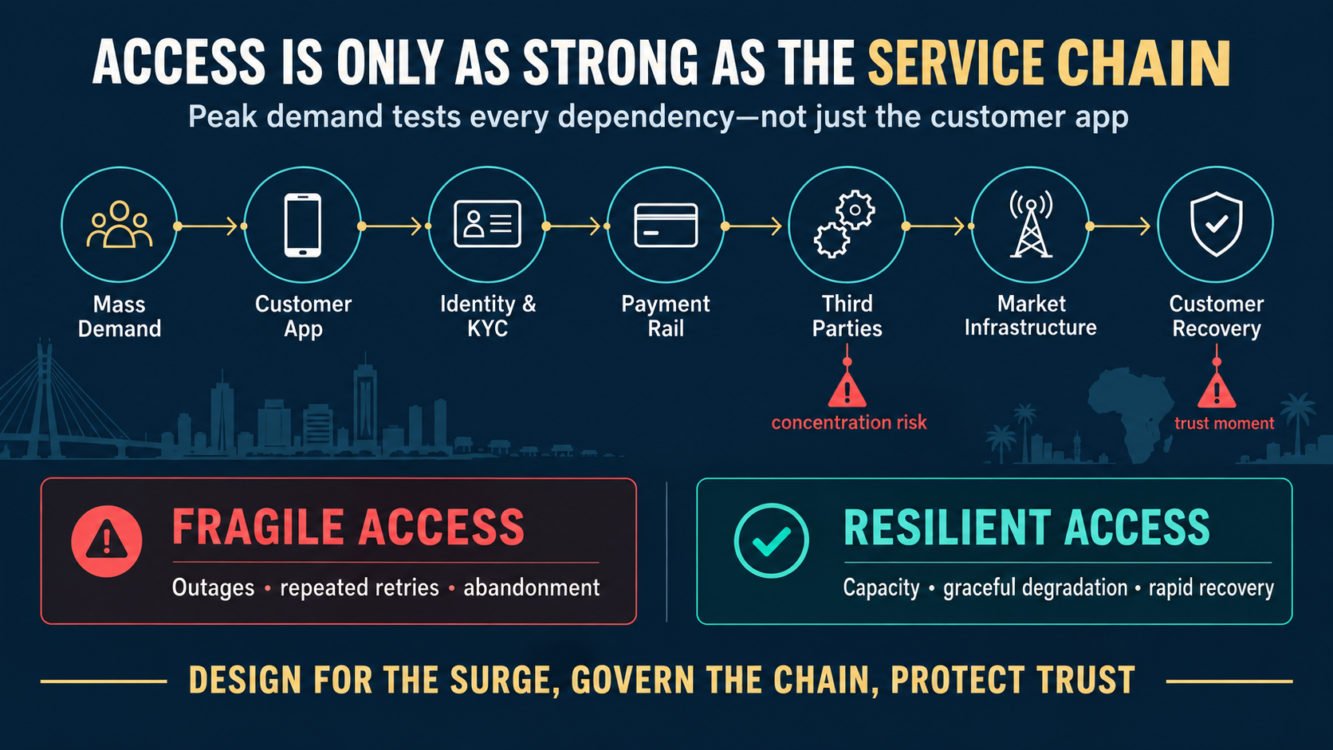
Boards often receive digital-resilience reporting in technology categories: application uptime, cloud availability, cyber incidents and recovery time. Customers experience something different. They experience an end-to-end service.
For a digital investment journey, that service may depend on:
- the mobile or web interface;
- identity, KYC and account-validation services;
- payment gateways, banks and settlement rails;
- APIs and other third-party providers;
- brokers, registrars and market infrastructure;
- messaging and transaction-confirmation services; and
- customer support and exception handling.
A front-end platform may be technically available while customers remain unable to fund accounts, verify identity or confirm an order. Conversely, a platform outage can be made worse when customers retry repeatedly, support channels become congested and alternative routes are communicated inconsistently.
This is why operational resilience should be organised around critical customer services, not isolated systems.
Peak demand exposes third-party concentration
The Reuters account is particularly instructive because Bamboo said the surge affected some third-party service providers and compounded the disruption. This pattern is common across digital businesses.
An organisation can invest heavily in its own scalable architecture while relying on a payment provider, identity service, cloud component or communications gateway that cannot absorb the same load. Multiple businesses may also depend on the same provider, creating correlated failure during a market-wide event.
Vendor-management processes rarely answer the question that matters most: can this provider support us when every client needs capacity simultaneously?
Contracts and service-level agreements remain necessary, but they do not create resilience by themselves. Management needs evidence from load tests, dependency maps, recovery exercises and credible fallback arrangements. Where substitution is difficult, the board should understand the resulting concentration explicitly.
Resilience and fraud prevention must be designed together
The IPO also creates a trust challenge. Reuters reported that Nigeria’s Securities and Exchange Commission urged investors to verify approved channels before transferring funds or sharing personal information. Analysts warned that strong public interest could attract phishing, cloned websites and impersonation attempts, although the SEC had not reported fraud cases in connection with the offer.
This risk is heightened when first-time users encounter service disruption. Customers searching for alternative channels, support numbers or payment instructions can become more susceptible to convincing but fraudulent substitutes.
The control response should therefore connect capacity management with fraud monitoring, approved-channel communication and customer education. During a disruption, organisations need a single authoritative status message, clearly identified recovery routes and rapid detection of impersonation activity.
Trust is not preserved by uptime alone. It is preserved by how the organisation behaves when uptime fails.
Five executive actions
1. Stress-test the critical service, not only the application
Simulate the complete customer journey at severe but plausible volumes. Include identity, payments, APIs, registrars, messaging, support and manual exceptions.
2. Map capacity and concentration across the dependency chain
Identify which internal components and external providers have the lowest headroom. Assess where several critical services depend on the same vendor or infrastructure.
3. Design graceful degradation
Decide which functions must remain available under stress. Queue requests safely, reduce non-essential features, prevent uncontrolled retries and give customers reliable status information.
4. Integrate technology, operations, risk and communications
Peak-demand events cannot be managed by IT alone. Product owners, operations, fraud, compliance, customer service, communications and third-party managers need shared triggers and decision rights.
5. Measure customer outcomes
Boards should see more than uptime. Useful indicators include transaction-completion rate, time to confirmation, failed and duplicate attempts, abandonment, support demand, recovery time, third-party performance and fraud alerts during disruption.
The board-level lesson
The Dangote IPO shows the promise of digitally widening ownership in African capital markets. It also shows that democratising access is an operational commitment, not merely a distribution strategy.
As more African businesses use digital platforms to reach customers at scale, resilience will increasingly determine whether moments of high demand create growth—or erode confidence. The organisations that earn trust will not be those that promise their systems can never fail. They will be those that understand the entire service chain, reduce avoidable fragility and recover with clarity when pressure arrives.
The board should ask:
If a major market event sent ten times the normal demand through our most important digital service, could customers still complete the transaction—and do we know which dependency would decide the answer?
How Trimm Solutions can help
Trimm Solutions helps organisations strengthen digital operating models, map critical service dependencies, redesign processes and controls, improve third-party governance, and build management information that connects technology performance with customer and business outcomes.