-
israel nnanna
- September 23, 2026
Banks do not fail liquidity tests because every source of funding disappears at once. They can fail because the route from an available source to usable cash contains too much uncertainty.
That distinction came into focus on 22 September 2026, when Federal Reserve Vice Chair Philip Jefferson discussed recent operational improvements to the U.S. discount window. Reuters reported that a self-service portal now handles 60% of discount-window loans and enables banks to communicate electronically with their regional Federal Reserve Bank. Jefferson also highlighted the ability to pledge Treasury collateral late in the day and receive a loan the same day.
The Federal Reserve describes the discount window as a facility through which eligible depository institutions can borrow after executing the relevant legal agreements and pledging collateral. Jefferson’s wider point was that reducing operational friction helps the facility act as a shock absorber and reduces the risk of forced asset sales during market stress.
The discount window is specific to the United States. The management lesson is universal: liquidity is not only a balance-sheet position. It is an end-to-end operating capability.
The gap between available and usable liquidity
A bank can hold high-quality liquid assets, maintain committed facilities and meet its regulatory ratios while still carrying execution risk. A facility shown in a contingency funding plan may depend on legal documentation, collateral eligibility, valuation, internal approvals, system access, counterparty operating hours and settlement infrastructure.
During normal conditions, these dependencies can appear administrative. During stress, they determine whether money arrives before an obligation falls due.
The relevant question is therefore not simply, “How much liquidity do we have?” It is, “How much can we convert into settled cash within each critical time horizon?” A board needs visibility over the difference between same-day, next-day and longer-dated liquidity, including the operational conditions attached to each source.
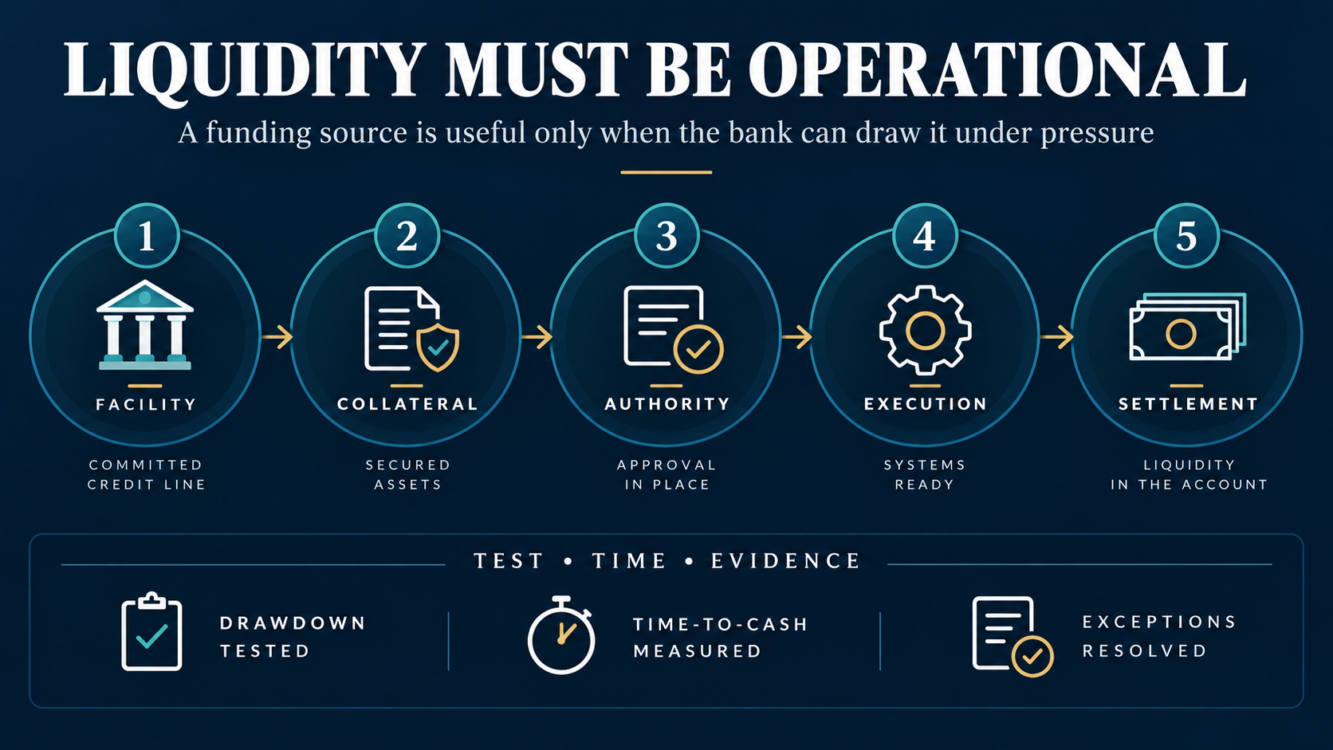
A five-stage readiness chain
1. Facility
The starting point is a credible source of funds: central-bank access, a committed interbank line, secured borrowing capacity or another approved contingency source. Management should distinguish committed facilities from expressions of interest and assumptions about market access. Capacity can also change when a counterparty, currency or instrument is under stress.
2. Collateral
Collateral must be identified, legally available, correctly documented and acceptable to the provider. Treasury needs current information on location, ownership, encumbrance, market value and applicable haircut. An asset that is eligible in principle but cannot be transferred or valued promptly should not be counted as immediately usable liquidity.
3. Authority
Decision rights must match the time available. Who can authorise a drawdown? What happens outside normal working hours? Can alternates act if a key executive is unavailable? Are the limits in the treasury mandate, delegation of authority and banking documentation consistent? Ambiguity at this stage can consume the window that the funding was intended to protect.
4. Execution
The bank must be able to access the relevant portal or communication channel, submit accurate instructions, complete security checks and resolve exceptions. This requires trained staff, tested credentials, resilient connectivity, current procedures and support arrangements. A process last used several years ago may no longer reflect the bank’s people, systems or organisation structure.
5. Settlement
The test is complete only when funds arrive in the correct account and are available for the intended obligations. Confirmation messages, accounting entries, liquidity dashboards and regulatory reporting should reconcile. Otherwise, management may believe liquidity has been raised while operations cannot yet deploy it.
Why this matters for African banks
The Fed’s reforms should not be transplanted mechanically into another regulatory system. But the underlying discipline is relevant to Nigerian and other African banks operating across currencies, payment systems, subsidiaries and markets with varying depth.
Periods of rapid exchange-rate movement, sovereign repricing, deposit concentration or market uncertainty can compress decision time. Foreign-currency funding may be available on different terms from local-currency liquidity. Collateral recognised at group level may not be readily transferable across legal entities. A facility may also rely on an external counterparty whose own risk appetite changes during the same stress event.
This makes liquidity readiness a joint responsibility. Treasury owns funding execution; finance ensures accurate positions and accounting; risk defines triggers and limits; operations manages settlement; legal confirms enforceability; technology protects access and availability; and senior management exercises the decision rights. The chain is only as strong as its least-prepared owner.
Five executive actions
1. Build a source-to-settlement inventory. For every material contingency source, document its capacity, currency, collateral, haircut, approvals, cut-off times, systems, settlement route and named owners.
2. Measure time-to-cash. Replace broad labels such as “available” with evidence-based time bands. Record the time taken at each stage and identify the longest handoff.
3. Conduct controlled drawdown tests. Test facilities periodically where permitted and proportionate. Include late-day or reduced-staff scenarios, not only rehearsals during ideal operating hours.
4. Resolve exceptions to closure. Treat rejected collateral, expired credentials, inconsistent mandates and reconciliation breaks as risk issues with owners and deadlines—not as observations filed after an exercise.
5. Give the board an evidence-based view. Report tested capacity, untested assumptions, concentration, time-to-cash and remediation status. A nominal total without operational qualification can overstate resilience.
The board-level question
If the bank’s primary funding market closed this afternoon, could management demonstrate how much cash would settle by close of business, which collateral would support it, who would authorise it and what could still prevent execution?
Liquidity resilience is not proven by possessing a policy or facility. It is proven by the institution’s ability to move from trigger to decision, from collateral to execution, and from execution to cash within the time the business actually has.
Trimm Solutions helps financial institutions connect risk frameworks with executable processes, decision rights, controls and management information. We can support liquidity-operating-model reviews, cross-functional simulations and remediation programmes that turn documented contingency plans into tested capability.