-
israel nnanna
- September 24, 2026
Separating a fast-growing business can make its value more visible. It can also reveal that the business does not yet own many of the capabilities on which its success depends.
Airtel Money provides a timely African case. On 23 September 2026, Reuters reported that the mobile-money business planned to file for a London initial public offering. The transaction is expected to involve existing shares and result in a free float of at least 10%. A source close to the matter said the offer could raise about $800 million and imply a market capitalisation of $8–$9 billion; final offer and pricing details were still expected in October.
Those figures remain prospective rather than final. What is already strategically important is the operating-model question behind the transaction. Airtel Africa currently owns about 78% of Airtel Money and plans to remain a long-term investor. Airtel Money operates across sub-Saharan Africa and reported about 53 million monthly active users and £399 million of revenue for the quarter ended 30 June, according to Reuters.
For boards considering a carve-out, subsidiary IPO or partial sale, the central question is not simply what the business is worth. It is whether the business can perform independently without losing the group capabilities that helped create that value.
Financial separation is only the visible layer
Companies often begin separation planning with legal structure, audited financial statements, tax, capital and transaction documentation. These are essential. They do not by themselves establish operational independence.
A digital-finance business inside a telecommunications group may benefit from the parent’s distribution network, customer relationships, brand, identity systems, data, procurement scale, cybersecurity operations, treasury and regulatory capabilities. Some of these connections should continue after listing. Others may need to be rebuilt inside the new entity. The risk lies in leaving them implicit.
When dependencies are poorly understood, standalone accounts can conceal the real economics. The parent may absorb costs that the subsidiary will eventually carry. Shared staff may make decisions without formal authority in the new structure. Technology teams may support both entities without measurable service levels. A failure, compliance breach or customer complaint may cross the new legal boundary faster than accountability does.
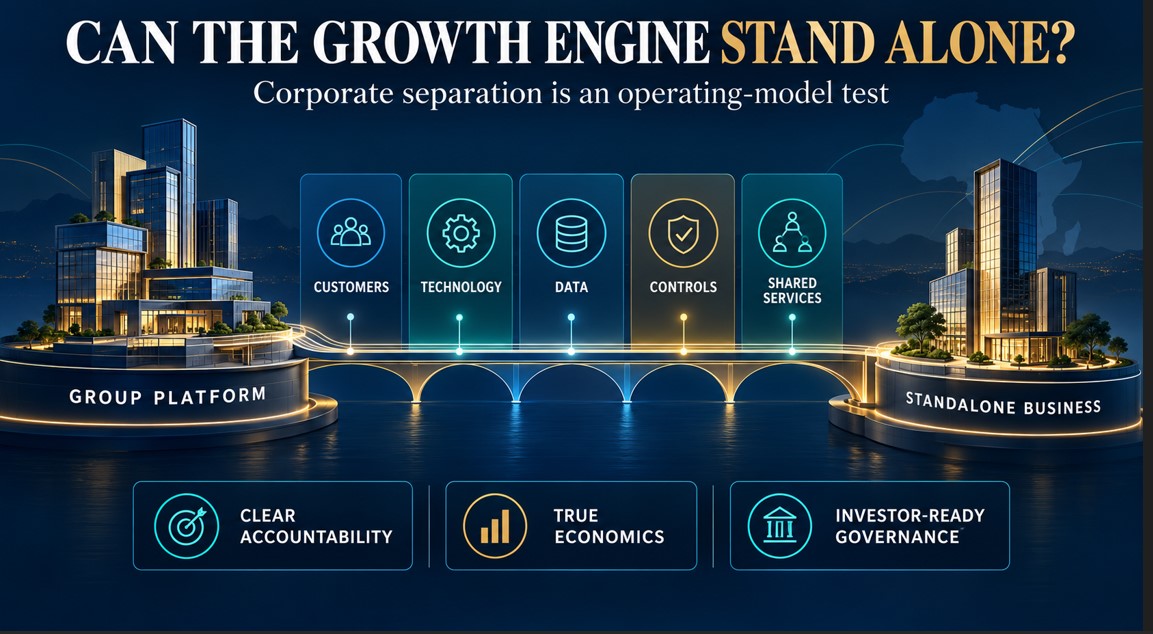
Five bridges determine whether separation works
1. Customers
Management must establish who owns the customer relationship, consent, complaints and service recovery. Where the growth business is distributed through the parent’s channels, it needs durable commercial access rather than goodwill. Customer journeys should be tested across both entities so that users do not experience organisational separation as fragmented service.
2. Technology
Map applications, infrastructure, interfaces, licences, cybersecurity tools and technical teams. Decide which assets will transfer, which services the parent will continue providing and which capabilities the new entity must build. Transitional arrangements need exit dates and migration plans; otherwise, temporary dependence becomes permanent complexity.
3. Data
Customer, transaction and operational data may have been collected or enriched across the group. The separated entity needs defined rights to use, store and share that information, supported by consent, privacy controls, retention rules and data-quality ownership. A legal transfer without usable data—or usable data without clear legal authority—creates different forms of risk.
4. Controls
The new business needs its own control environment proportionate to its risk. This includes financial controls, fraud management, regulatory reporting, access management, third-party oversight, incident management and internal assurance. Copying the parent’s control catalogue may be insufficient if responsibilities, systems and risk exposures have changed.
5. Shared services
Finance, HR, legal, procurement, treasury and risk functions are frequently shared. Management should identify the full cost and service requirement for each. Formal service agreements need measurable standards, pricing, escalation and continuity provisions. Investors should be able to distinguish the subsidiary’s genuine profitability from benefits that depend on unpriced group support.
Make the economics visible
A separation programme should produce a credible standalone cost base. This requires more than allocating current group overhead. Some duplicated costs will appear immediately; others will emerge when the entity needs independent leadership, systems, governance, reporting and regulatory capacity.
The CFO should present a bridge from current reported performance to steady-state standalone economics. It should distinguish costs that transfer, services purchased from the parent, new capabilities to be built, one-off separation expenditure and efficiency opportunities. Transfer pricing and related-party transactions should be transparent enough for boards and investors to understand where value is created.
The same transparency is required for revenue. If customer acquisition depends on the parent’s network, brand or bundled offering, the commercial arrangement must be durable and appropriately priced. Revenue is not fully independent when access to the customer remains discretionary.
Five executive actions
1. Build a dependency register. Map the people, processes, systems, data, contracts, licences, facilities and decisions the business receives from the group. Assign an owner and separation treatment to every critical dependency.
2. Define the target operating model. Specify the standalone organisation, decision rights, governance, controls and capabilities required at listing and after transition.
3. Establish formal service agreements. For continuing group services, define scope, cost, service levels, escalation, resilience and termination arrangements.
4. Test operational scenarios. Simulate customer onboarding, technology incidents, fraud events, month-end reporting and regulatory submissions across the new boundary. Test what happens when the parent service is unavailable.
5. Track readiness separately from transaction progress. Legal filings and investor roadshows can advance while operational readiness lags. Give the board an integrated dashboard covering both.
The board-level question
If the group stopped providing informal support tomorrow, which customer journey, control or critical operation would fail first—and is that dependence visible in the valuation story?
The Airtel Money transaction may demonstrate the depth of international investor appetite for African digital-finance infrastructure. It also illustrates a broader principle: separation does not create independence. Independence must be designed, costed, governed and tested.
Trimm Solutions helps boards and executive teams translate corporate strategy into executable operating models. We support dependency assessments, process and control design, governance, service agreements, financial visibility and separation-readiness programmes.