-
israel nnanna
- September 21, 2026
Technology markets often move faster than commercial evidence. A compelling demonstration attracts headlines, investors and policy support. Valuations rise in anticipation of a market that may still be forming. Eventually, however, capital asks a more demanding question: is the innovation solving a problem that independent customers will pay to solve repeatedly?
China’s humanoid-robot sector is now confronting that transition.
Reuters reported on 21 September 2026 that Chinese regulators were slowing some humanoid-robot listing applications while examining whether high valuations and revenue connected to government-backed projects reflect sustainable commercial demand. The reported action involves informal guidance rather than a formal ban, and Beijing continues to promote embodied intelligence as a strategic emerging industry.
The development is not a verdict on robotics. It is a signal that the market is moving from excitement about technical potential toward evidence of commercial readiness.
Capability is only the first investment question
Humanoid robots can increasingly navigate human environments, manipulate objects and perform complex tasks. Yet global commercial deployment remains modest.
Separate figures reported by Reuters from the International Federation of Robotics indicate that approximately 7,000 humanoid robots were sold globally for industrial and professional-service applications in 2025. This compares with 542,000 conventional industrial robots and 199,000 professional-service robots. Many humanoids are still used in research and data-collection roles, while manufacturers are testing limited factory applications.
A technology can therefore be strategically important and technically impressive without yet supporting every valuation placed upon its producers.
This distinction matters well beyond robotics. It applies to artificial intelligence, fintech, climate technology, IoT, digital health and every market where capital arrives ahead of mature customer demand.
Revenue quality matters as much as revenue growth
Reuters reported that regulators were focusing particularly on revenue generated through local-government-backed projects, including data-collection centres and joint ventures where public entities may provide most of the initial investment. Such projects can accelerate learning and market development. They can also make it difficult to distinguish temporary ecosystem support from independent demand.
Boards and investors should not automatically discount sponsored or government-backed revenue. They should classify it correctly.
A useful revenue-quality bridge separates:
- independent commercial customers;
- repeat orders and renewals;
- pilots expected to convert into scaled contracts;
- government or development-sponsored programmes;
- related-party and joint-venture revenue; and
- non-recurring equipment, implementation or research income.
Two companies reporting the same revenue growth can have very different underlying economics. One may have diversified customers, renewal evidence and improving margins. The other may depend on one sponsor, exceptional projects and continued capital support.
The six stages of commercial readiness
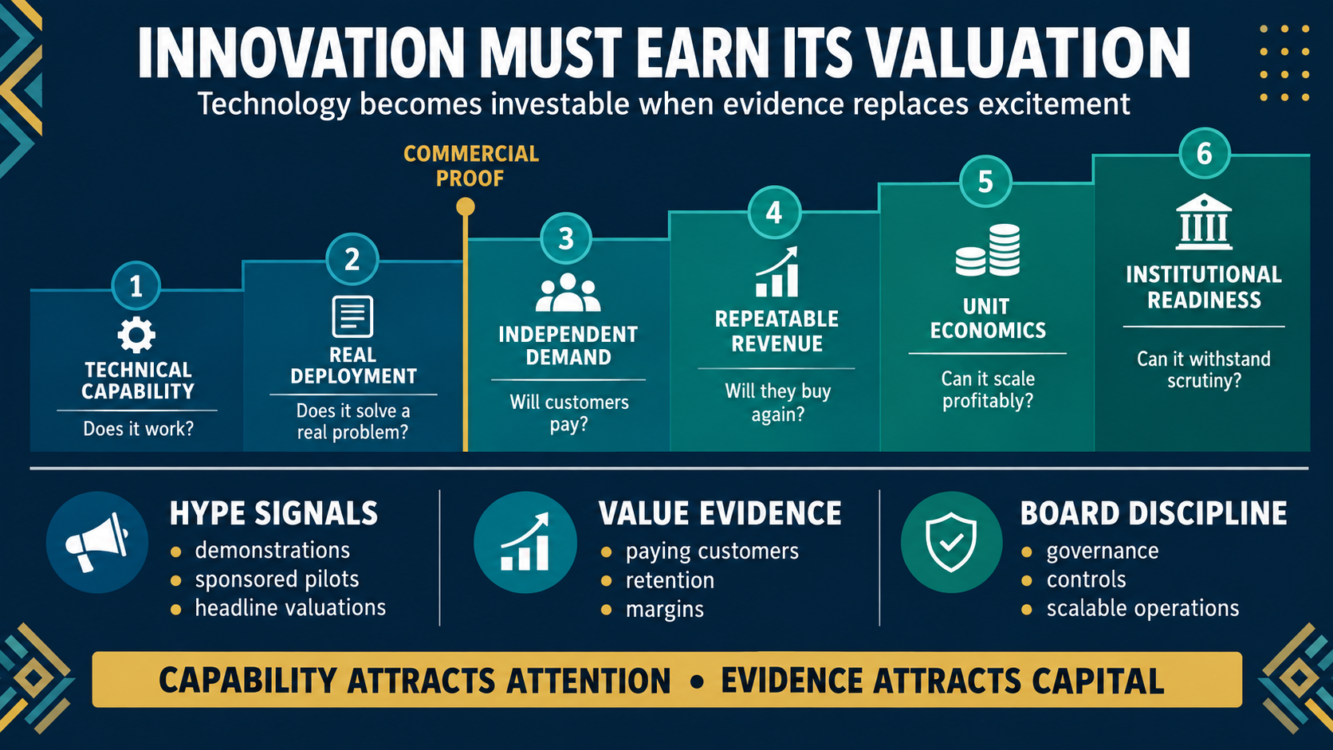
Executives can evaluate innovation more clearly by separating six stages.
1. Technical capability
Does the product work under controlled conditions? This establishes feasibility, not commercial viability. Evidence should include performance, reliability, safety and the limits within which the technology operates.
2. Real deployment
Does it solve a material problem in the customer’s operating environment? A demonstration becomes more valuable when it survives real data, users, processes, infrastructure and exceptions.
3. Independent demand
Will customers commit their own money without a sponsor creating the transaction? This is the commercial-proof threshold. Signed contracts, competitive wins and willingness to pay matter more than expressions of interest.
4. Repeatable revenue
Will customers renew, expand or recommend the solution? Management should track pilot conversion, retention, utilisation, sales-cycle length and revenue concentration. One major contract may validate relevance but not repeatability.
5. Unit economics
Can the company deliver profitably as it scales? Gross margin, implementation effort, support cost, working capital, customer-acquisition cost and cost-to-serve reveal whether growth creates or consumes value.
6. Institutional readiness
Can governance, financial reporting, controls, talent and operations withstand investor and regulatory scrutiny? Innovative businesses frequently outgrow founder-led decisions and informal processes before management recognises the risk.
Implications for African growth companies
African technology and infrastructure ventures often develop in markets where customers face capital constraints and governments or development institutions play an important catalytic role. Sponsored pilots and concessionary funding can be essential to proving a solution.
The risk begins when temporary support is presented as evidence of permanent demand.
Founders preparing to raise capital should therefore document the path from pilot to commercial contract. They should show which customers pay independently, why they renew, how margins change with scale and where delivery remains dependent on scarce talent or imported technology.
This discipline improves more than investor confidence. It helps management decide which products deserve further investment, which customers create genuine reference value and which revenues distract from a scalable core.
The corporate-transformation parallel
The same framework applies inside established organisations. AI, ERP, automation and analytics programmes often receive approval after successful demonstrations. Yet a pilot may operate with exceptional support, clean data and a narrow process scope that will not exist at enterprise scale.
Before scaling, executives should require evidence that the solution produces sustained user adoption, measurable process improvement, manageable control risk and favourable total economics. Technical success is necessary; it is not sufficient.
The board-level question
Capital should support ambition, but valuation must rest on evidence. The strongest innovative companies will not be those that avoid pilots, public partnerships or early enthusiasm. They will be those that convert these advantages into independent demand, repeatable economics and institutional strength.
The board should ask:
If policy support, sponsorship and pilot funding disappeared, which part of our growth story would remain supported by independent customers, repeatable revenue and credible unit economics?
How Trimm Solutions can help
Trimm Solutions helps growth companies and established enterprises assess commercial readiness, strengthen business cases, improve financial and management reporting, redesign operating models, establish scalable controls, and prepare for institutional capital and enterprise-wide transformation.