-
Trimmsolutions
- September 21, 2026
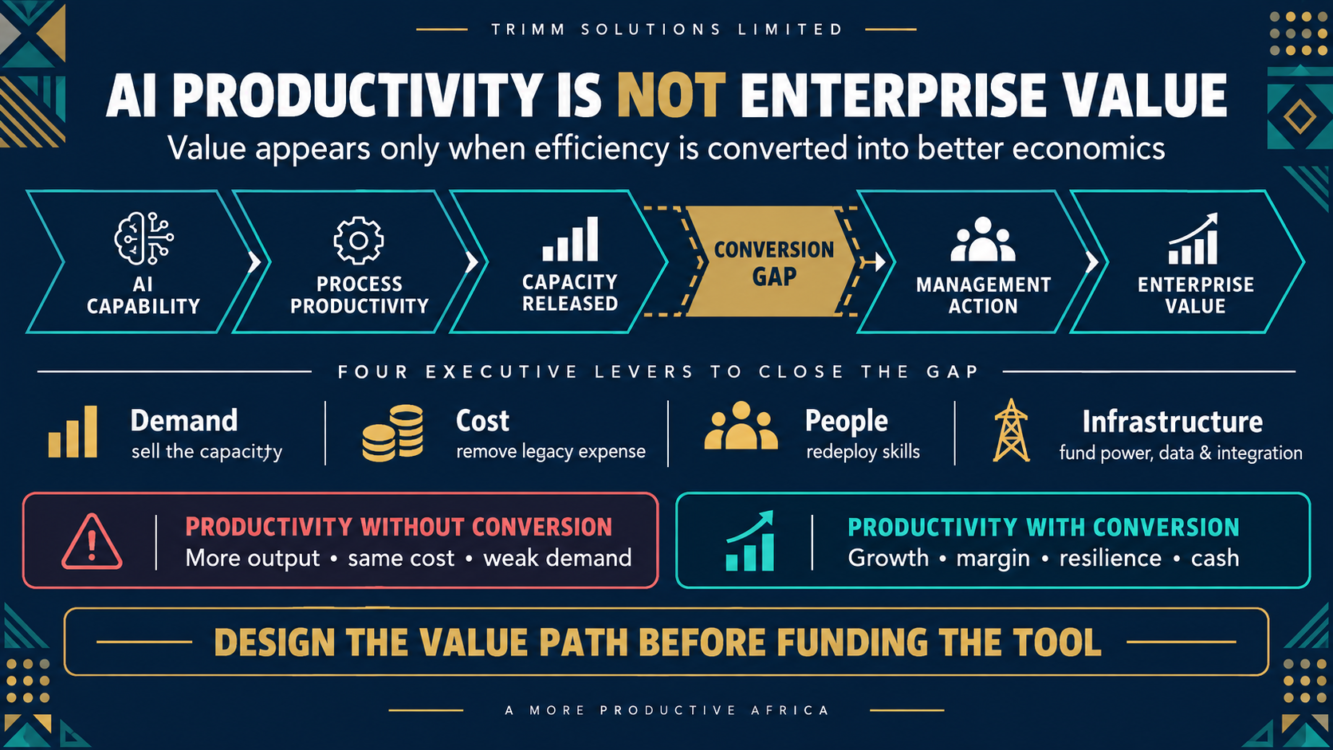
The case for artificial intelligence is often expressed in productivity terms: faster analysis, shorter processing times, more output per employee and fewer manual activities. These gains matter. But productivity is an intermediate outcome—not the final measure of business value.
Recent warnings from the International Monetary Fund and a Chinese central-bank policy adviser highlight why this distinction deserves board attention.
An IMF paper presented to European Union finance ministers on 18–19 September 2026 estimated that AI could lift European productivity by approximately 1% over five years. It also warned that benefits would be uneven, about 60% of workers in advanced European economies hold jobs highly exposed to AI, and rising data-centre demand could strain electricity networks. Separately, People’s Bank of China policy adviser Huang Yiping said wider AI deployment could worsen China’s imbalance between strong supply and weak demand.
The implications extend beyond Europe and China. Every enterprise investing in AI must answer the same question: how will greater productive capacity become stronger economics?
The AI conversion gap
AI can compress the time required for research, reporting, customer service, coding, reconciliation and many other activities. If a process previously required ten people and now needs six, the organisation has released capacity.
That release does not automatically improve profit.
If all ten people remain assigned to the same work, labour cost may be unchanged. If the additional output cannot be sold, inventory or unused capacity may increase. If the technology requires significant cloud consumption, integration, data preparation and control expenditure, gross savings may be offset by new costs.
Enterprise value emerges only after management decides how to use, redeploy or remove the released capacity. That is the conversion gap between productivity and measurable benefit.
More supply does not create its own demand
Huang’s warning about China is relevant to corporate strategy. AI can strengthen the supply side by helping companies design products, produce content, process transactions and manufacture goods more efficiently. But customer demand may not increase at the same rate.
A Nigerian bank can automate credit processing without creating enough qualified borrowers. A manufacturer can improve throughput while distributors and consumers remain constrained. A professional-services firm can produce analysis faster while clients resist higher volumes or fees.
Before funding an AI initiative, executives should identify the demand mechanism. Will faster service improve conversion or retention? Will lower unit cost enable a new customer segment? Can capacity support regional expansion, product innovation or better customer experience?
If demand is uncertain, the investment case should not treat additional output as realised value.
Cost savings require cost decisions
Many AI business cases use hours saved as a proxy for financial benefit. This is useful for measuring operational improvement, but it is not equivalent to cash savings.
Savings reach the income statement only when management changes the cost structure. That may involve removing duplicated activities, reducing contractor expenditure, avoiding future recruitment, consolidating systems, redesigning spans of control or reallocating employees to revenue-generating work.
These decisions are organisational, not technical. They require process redesign, role clarity, workforce planning and often difficult choices about legacy activities. An AI tool can release capacity; it cannot decide how leadership will use it.
The infrastructure bill belongs in the business case
The IMF paper also connects AI growth with power and technology dependence. Reuters reported that Europe’s data centres already consume roughly 3% of the continent’s electricity, with demand expected to rise as AI adoption expands.
For African enterprises, the infrastructure constraint can be more immediate. AI economics may include cloud consumption, connectivity, backup power, data engineering, cybersecurity, system integration and specialised talent. Foreign-currency pricing can further increase volatility.
Boards should therefore require total-cost-of-ownership analysis rather than licence-price comparisons. The business case should consider usage growth, model switching, data movement, vendor lock-in and the cost of maintaining safe, reliable operations.
Five stages from capability to value
Executives can strengthen AI benefits realisation by governing five connected stages.
1. Define the capability
Specify the decision, task or customer outcome the AI will improve. Avoid broad objectives such as “increase efficiency” without an operational baseline.
2. Measure process productivity
Track cycle time, throughput, quality, error rates, employee effort and customer outcomes before and after implementation. Validate whether improvement is genuinely attributable to the intervention.
3. Quantify released capacity
Translate productivity into hours, roles, infrastructure or working capital. Distinguish theoretical capacity from capacity management can practically redeploy or remove.
4. Commit to management action
Decide who will sell, redeploy, remove or reinvest the released capacity. Assign named owners and dates. This is the point where an operational benefit becomes an economic decision.
5. Verify enterprise value
Measure realised revenue, margin, cost avoidance, cash release, customer improvement or risk reduction. Compare results with the original case and adjust funding accordingly.
A cross-functional accountability model
Closing the conversion gap requires more than a technology steering committee. The CFO should validate financial benefits and prevent double counting. The COO should own process redesign and capacity decisions. HR should manage role changes and redeployment. The CIO should disclose the full technology and dependency cost. Business leaders should own demand creation and customer outcomes.
Boards should receive a benefits-realisation view that separates productivity achieved, capacity released, management action completed and value verified. Combining them into one headline “AI benefit” figure conceals the decisions still required.
The board-level question
AI can make an organisation more capable without making it more valuable. The difference lies in whether management has designed a credible path from efficiency to economics.
The board should ask:
If every proposed productivity gain is achieved, what specific actions will convert the released capacity into growth, margin, resilience or cash, and who is accountable for completing them?
How Trimm Solutions can help
Trimm Solutions helps organisations build AI and transformation business cases, redesign processes and operating models, establish benefits-realisation governance, assess technology economics, and create executive dashboards that connect operational improvement with measurable enterprise value.