-
israel nnanna
- September 15, 2026
Oil prices above $100 per barrel attract immediate attention because of what they mean for motorists, airlines, manufacturers and energy companies. The more consequential corporate impact, however, often emerges through a second channel: the cost of money.
On 14 September 2026, Reuters reported that Brent crude had risen above $106 per barrel after renewed attacks on Saudi Arabian infrastructure and escalating disruption around the Strait of Hormuz. The previous week had already produced an 8% increase in oil prices.
On the same day, Goldman Sachs and JPMorgan revised their expectations and forecast a U.S. Federal Reserve rate increase in September. Stronger-than-expected inflation data and oil above $100 weakened expectations of near-term monetary easing.
For Nigerian and African businesses, these are not separate stories. Together they create a potential double shock: higher operating costs and more expensive capital.
How the shock reaches the enterprise
The transmission begins with energy but does not end there.
Higher crude prices increase the cost of refined products, freight, aviation, distribution and energy-intensive production. Suppliers then pass part of the increase into materials and services. Businesses require more cash to purchase the same volume of inventory. Customers facing similar pressure may reduce demand or take longer to pay.
If higher energy costs keep inflation elevated, central banks may maintain or increase interest rates. Global investors can also move toward dollar assets, strengthening the currency and increasing pressure on emerging-market exchange rates and foreign-currency borrowing.
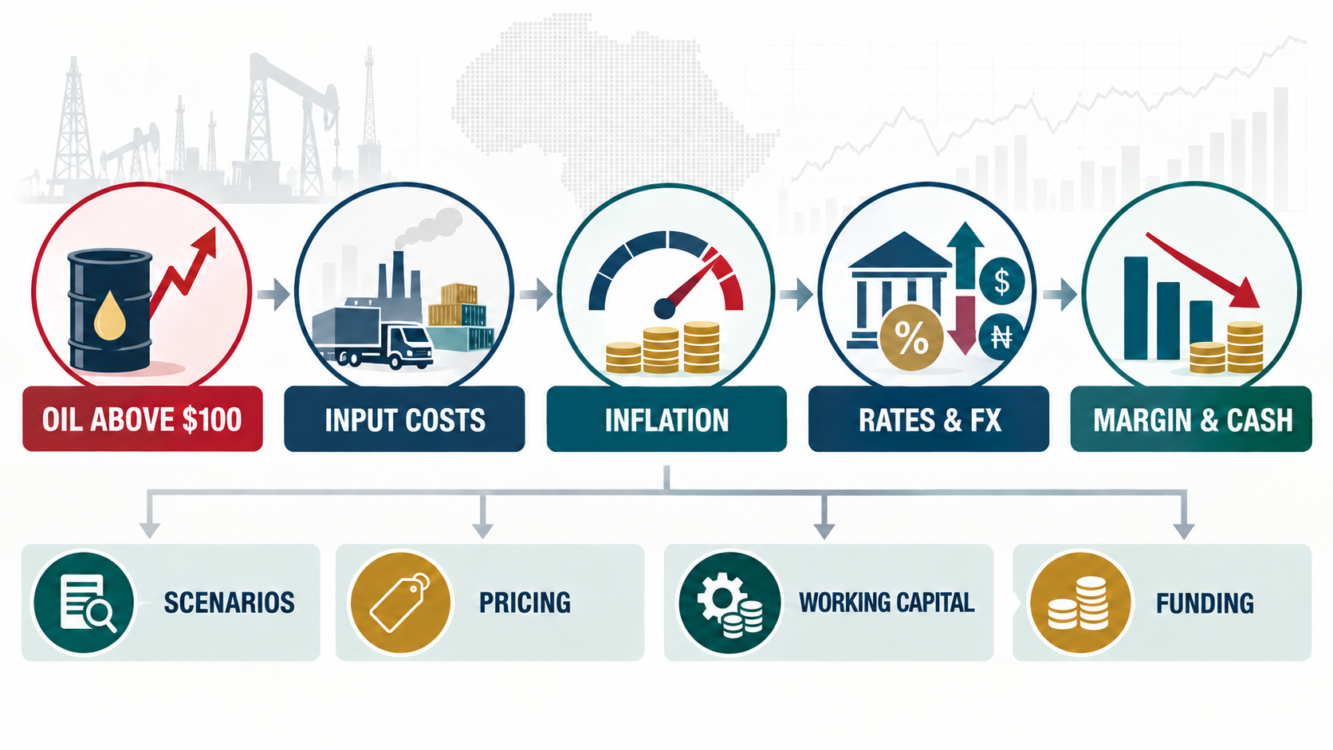
Oil shock → input-cost inflation → monetary tightening and FX pressure → weaker margins, higher working-capital needs and more expensive funding.
Management teams that monitor only the direct fuel-cost line will underestimate the exposure.
Nigeria’s position is both favourable and vulnerable
Nigeria is an oil producer. Higher crude prices can strengthen export receipts, government revenue and foreign-exchange inflows—particularly when domestic production is reliable.
But the corporate impact is uneven.
The IMF’s June 2026 assessment of Nigeria noted that higher global fuel, food and fertiliser prices could improve exports and fiscal revenues while also increasing inflationary pressure and aggravating hardship. That tension is important for corporate planning.
Most Nigerian businesses are not crude exporters. They experience high oil prices through transport, diesel, imported inputs, logistics, supplier pricing and weakened consumer purchasing power. Companies with foreign-currency obligations face the additional risk that tighter global monetary conditions increase exchange-rate and refinancing pressure.
Even producers and energy-service companies that benefit from stronger sector activity can face cost escalation, project delays and higher contractor rates.
The correct question is therefore not whether high oil prices are “good” or “bad” for Nigeria. It is how the benefits and costs move through each organisation’s revenue, cost, cash and funding model.
Why static budgets are insufficient
Annual budgets often assume a single exchange rate, interest rate, energy price and sales-growth path. Those assumptions can become obsolete within weeks during a major external shock.
The problem is not that management failed to predict the future. The problem is that the organisation may lack a prepared response when assumptions change.
Scenario planning should connect external variables directly to management decisions. If oil remains above $100, how quickly can prices be adjusted? Which customer contracts allow cost pass-through? How much additional cash will be tied up in inventory and receivables? Which capital projects remain viable at a higher hurdle rate?
A scenario that produces no predetermined action is merely an alternative forecast.
Four executive responses
1. Refresh scenarios around decision thresholds
Management should model at least three cases: a short-lived disruption, an extended period above $100 and a severe supply shock accompanied by additional monetary tightening.
Each case should specify trigger points for pricing, inventory, expenditure, credit and funding decisions. The objective is to reduce the time between market movement and executive action.
2. Strengthen pricing governance
Rapid cost inflation can destroy margin when pricing decisions move slowly or rely on incomplete data.
Companies should understand contribution margins by product, customer and channel. Contracts should be reviewed for indexation and cost-pass-through provisions. Approval thresholds may need to be adjusted so commercial teams can respond quickly without weakening control.
Pricing action should also consider customer economics. Passing every increase immediately may protect unit margin but damage volumes, collections or strategic relationships.
3. Protect working capital
Higher prices mean more cash is required to maintain the same operating capacity. A company purchasing 30 days of inventory may face a substantial liquidity increase even when physical volumes do not change.
Credit policies may also need revision. Customers facing cost pressure can delay payment, turning a margin problem into a liquidity problem.
4. Reassess funding and capital expenditure
Higher global rates can affect domestic borrowing costs, foreign-currency facilities and investor hurdle rates. CFOs should review refinancing dates, covenant headroom, floating-rate exposure and the currency composition of debt.
Capital projects should be stress-tested using updated energy, FX and discount-rate assumptions. Projects that appeared attractive under last quarter’s conditions may no longer clear the required return.
Deferring every investment is not necessarily the right response. Projects that reduce energy intensity, automate inefficient processes or strengthen supply resilience may become more valuable during a prolonged shock.
Create one integrated executive view
Energy, treasury, procurement, sales and operational-risk teams often monitor different pieces of the same exposure. That fragmentation slows management response.
The executive dashboard should connect:
Fuel and energy-price movements
Gross margin by product and customer
Inventory and receivable days
Cash-flow forecasts and covenant headroom
Foreign-currency exposures
Interest-rate sensitivity
Pricing actions and customer response
The aim is not more reporting. It is earlier, coordinated decision-making.
The leadership test is response speed
Oil prices may retreat if disruption eases. They may remain elevated if supply routes and infrastructure continue to face pressure. Management cannot control either outcome.
What leaders can control is how rapidly the organisation converts external signals into decisions on price, cash, operations and capital.
The board-level question is:
If oil remains above $100 and funding costs rise further, which part of our business model becomes uneconomic first—and what action should we take before that point is reached?
How Trimm Solutions can help
Trimm Solutions supports boards and executive teams with scenario modelling, finance and process transformation, working-capital improvement, management dashboards, operational-risk assessment and transformation governance. We help organisations translate market volatility into practical, coordinated decisions.
Sources
Reuters — Oil rises above $100 following renewed attacks, 14 September 2026