-
israel nnanna
- September 15, 2026
Artificial intelligence is not merely giving fraudsters another tool. It is changing the cost, speed and scalability of financial crime.
INTERPOL’s Global Financial Fraud Threat Assessment 2026, published on 16 March, estimates that AI-enabled financial fraud can be 4.5 times more profitable than non-enhanced tactics. The report describes how generative and agentic AI can support victim reconnaissance, credential harvesting, system infiltration, personalised manipulation and even the calculation of ransom demands.
The African dimension is especially important. INTERPOL reported on 3 August that AI enables 55% of reported cybercrimes across Africa. Its assessment, based on survey data from 36 member countries, says reported cybercrime losses on the continent have more than doubled since 2024—from $192 million to $484 million—driven principally by AI-facilitated scams, credential theft and automated social engineering.
For boards, banks, fintechs and other digital businesses, the central lesson is clear: controls designed for yesterday’s fraud economics will not reliably contain tomorrow’s attacks.
Why AI changes the fraud operating model
Traditional fraud often required significant manual effort. Criminals had to identify targets, build a credible story, communicate repeatedly and adapt their approach. That naturally constrained volume.
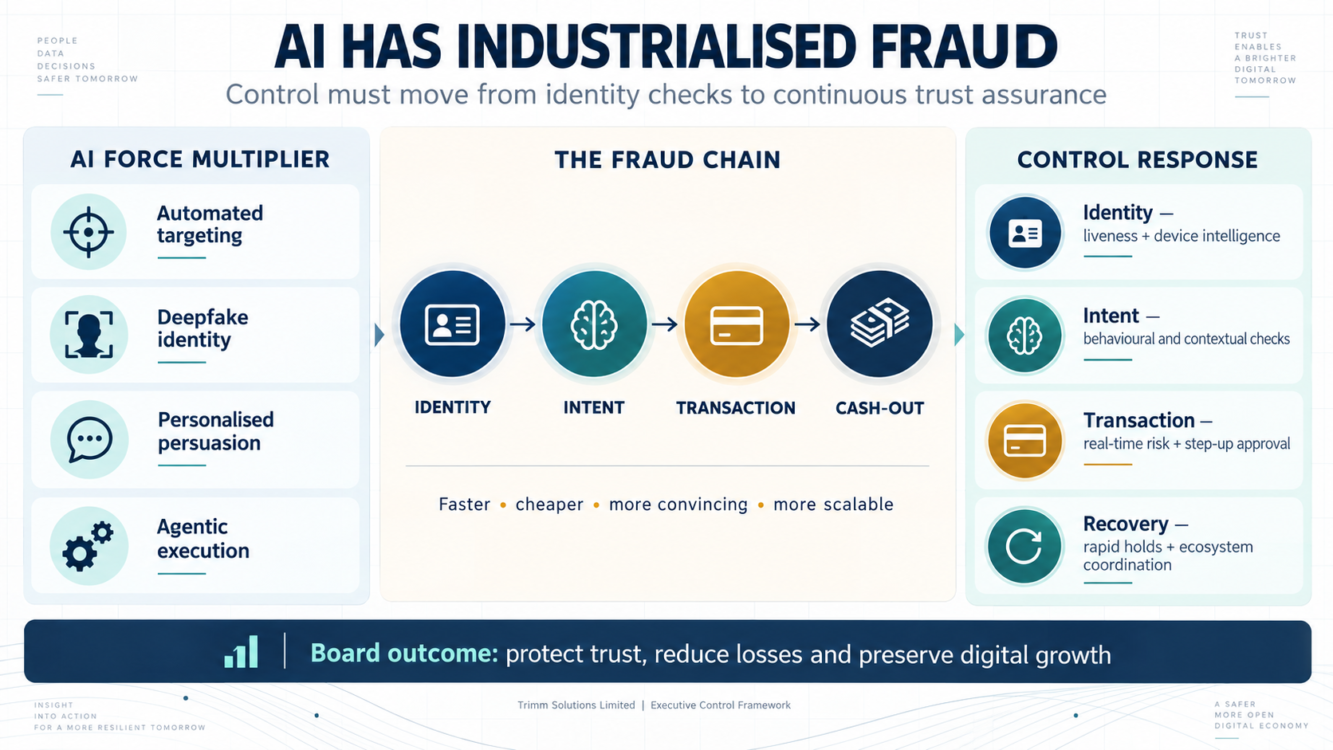
AI changes each variable. It can scan publicly available information, personalise messages, translate content, imitate an executive’s voice, construct synthetic identities and generate convincing documents at marginal cost. INTERPOL also warns that agentic AI can automate more of the end-to-end attack process.
The result is a dangerous combination: higher attack volumes and more persuasive interactions. When criminals can test thousands of tailored approaches, even a low conversion rate can produce attractive returns. INTERPOL’s finding that AI-enhanced fraud may be 4.5 times more profitable captures the commercial logic behind the threat.
This also changes the defender’s challenge. A suspicious email may no longer contain obvious grammatical errors. A video call may not prove that the visible person is real. A customer who passes an identity check may be acting under manipulation. A legitimate account may be controlled from a compromised device.
The control question must therefore move from “Did this person authenticate?” to “Does the full context support trust?”
Identity alone is no longer enough
Many digital-control environments still place disproportionate reliance on identity credentials: passwords, one-time codes, security questions, identity documents and facial matching. These controls remain necessary, but they are increasingly insufficient on their own.
AI-generated personas can combine real and fabricated information. Voice cloning can undermine informal call-back verification. Deepfakes can imitate trusted executives or relatives. Credential-harvesting attacks can allow criminals to enter through genuine accounts.
Organisations need a layered approach that considers four connected dimensions.
1. Identity: is the claimant real?
Stronger enrolment, liveness detection, document verification, device intelligence and protection against repeated synthetic-identity attempts are essential. Identity controls should be tested continually against new attack methods rather than treated as a completed implementation.
2. Intent: is the genuine customer acting freely and rationally?
Some fraud bypasses identity controls because the customer is persuaded to authorise the transaction. Behavioural signals, unusual urgency, new beneficiaries, scripted interactions and sudden changes in transaction patterns can indicate coercion or manipulation. Customer-facing teams need protocols for sensitive intervention without relying on generic warnings.
3. Transaction: does the activity make economic and contextual sense?
Real-time risk scoring should combine customer history, device behaviour, beneficiary risk, velocity, location and transaction purpose. High-risk actions may require step-up approval, cooling-off periods, lower limits or direct verification through a separate trusted channel.
4. Recovery: can the ecosystem act before the money disappears?
Fraud proceeds can move rapidly across multiple institutions and payment channels. Effective response requires immediate holds, clear escalation rights, fast customer contact and coordinated intelligence sharing among banks, fintechs, telecom operators and law enforcement. Recovery cannot begin only after a completed investigation.
The operating model must move as fast as the threat
The technology investment will underperform if responsibility remains fragmented.
Fraud teams may monitor transactions, cybersecurity teams protect infrastructure, AML teams investigate suspicious flows, customer-service teams receive complaints and operational-risk teams report aggregate losses. When these functions operate through separate workflows, critical signals arrive too late or lack context.
AI-enabled fraud requires a cross-functional operating model with common cases, shared data and explicit decision rights. Management should know who can suspend a transaction, block a beneficiary, contact a customer, preserve evidence and notify external partners. Those decisions need defined service levels measured in minutes—not committee cycles measured in days.
This is particularly relevant in Africa, where INTERPOL identified the absence of real-time data sharing among banks, telecom operators and law-enforcement agencies as a significant blind spot. No single institution can see the entire attack chain. Digital trust is increasingly an ecosystem outcome.
Five actions for executive teams
1. Reassess fraud risk using AI-enabled attack scenarios. Test deepfake executive instructions, synthetic identities, manipulated customers, compromised devices and automated business-email compromise—not only historical fraud types.
2. Map controls across the complete fraud journey. Identify gaps from onboarding and authentication through transaction execution, cash-out and recovery. Assign an accountable executive to each critical handoff.
3. Integrate fraud, cyber, AML and operational-risk data. Build one decision view that connects identity, devices, behaviour, beneficiaries and transaction patterns. Technology architecture should support intervention, not simply retrospective reporting.
4. Introduce risk-based friction. Apply stronger verification to high-risk events while preserving a smooth experience for trusted customers. The goal is intelligent friction, not universal inconvenience.
5. Measure response economics. Boards should monitor time to detect, time to intervene, loss avoided, recovery rate, false positives, customer impact and repeat exposure. These measures reveal whether control investment is preserving trust and enterprise value.
The board question
AI will continue to improve customer service, financial inclusion and operational productivity. But the same economics that make digital services scalable also make digital fraud scalable.
The objective is not to slow innovation indiscriminately. It is to build control systems and decision processes capable of distinguishing trusted activity from manufactured credibility—quickly enough to act.
The question boards should ask is:
If identity can be fabricated and a genuine customer can be manipulated, what combination of evidence gives us sufficient confidence to execute a high-risk instruction?
How Trimm Solutions can help
Trimm Solutions helps financial institutions and digitally enabled businesses align process design, technology, controls, data and governance. We support fraud-control diagnostics, operating-model redesign, AI governance, operational-resilience planning and executive dashboards that turn fragmented risk signals into timely decisions.