-
israel nnanna
- September 11, 2026
Digital infrastructure decisions once appeared largely technical:
choose a network supplier, negotiate financing, implement the equipment
and manage performance. That view is becoming obsolete.
On 11 September 2026, Reuters reported that the U.S. Export-Import
Bank planned to lend nearly $100 million to Africell to fund
mobile-network technology from American and allied suppliers. Reuters
said the information came from a person familiar with the matter and a
draft press release expected later that day. The reported financing
forms part of Washington’s wider effort to promote alternatives to
Huawei in overseas communications infrastructure.
The details matter. Africell operates in Angola, the Democratic
Republic of Congo, Sierra Leone and The Gambia. Reuters reported that
Huawei holds approximately 52% of Africa’s 5G infrastructure market,
citing Counterpoint Research. The proposed transaction is therefore not
simply commercial lending. It links capital, equipment sourcing,
cybersecurity and geopolitical influence.
For African executives, the lesson is not that one geopolitical bloc
is inherently preferable to another. It is that financing and
technology architecture can no longer be evaluated
separately.
Infrastructure finance now carries strategic conditions
Capital rarely arrives without an operating logic. A loan may
influence the equipment that can be purchased, the suppliers that
qualify, the standards that are adopted and the partners that remain
available over the asset’s life.
That can be beneficial. Tied financing may reduce capital
constraints, accelerate deployment and bring credible suppliers into
difficult markets. It can also improve security, transparency and
implementation discipline.
However, the same structure may create long-term dependencies.
Telecoms networks, cloud platforms, enterprise applications and AI
infrastructure are not easily replaced. Once data, processes, skills,
integrations and operating routines accumulate around a technology
stack, the cost of switching can become far greater than the original
purchase price.
Boards should therefore evaluate the strategic conditions
embedded in the capital, not only its interest rate and
tenor.
The real issue is dependency architecture
Technology risk is often assessed one supplier at a time. That misses
the system-level exposure.
A critical service may depend on a network-equipment vendor, a cloud
provider, an identity platform, international connectivity, specialist
implementation partners and foreign-currency licensing. Financing may
introduce another dependency. Regulation, sanctions or export controls
can then affect several layers simultaneously.
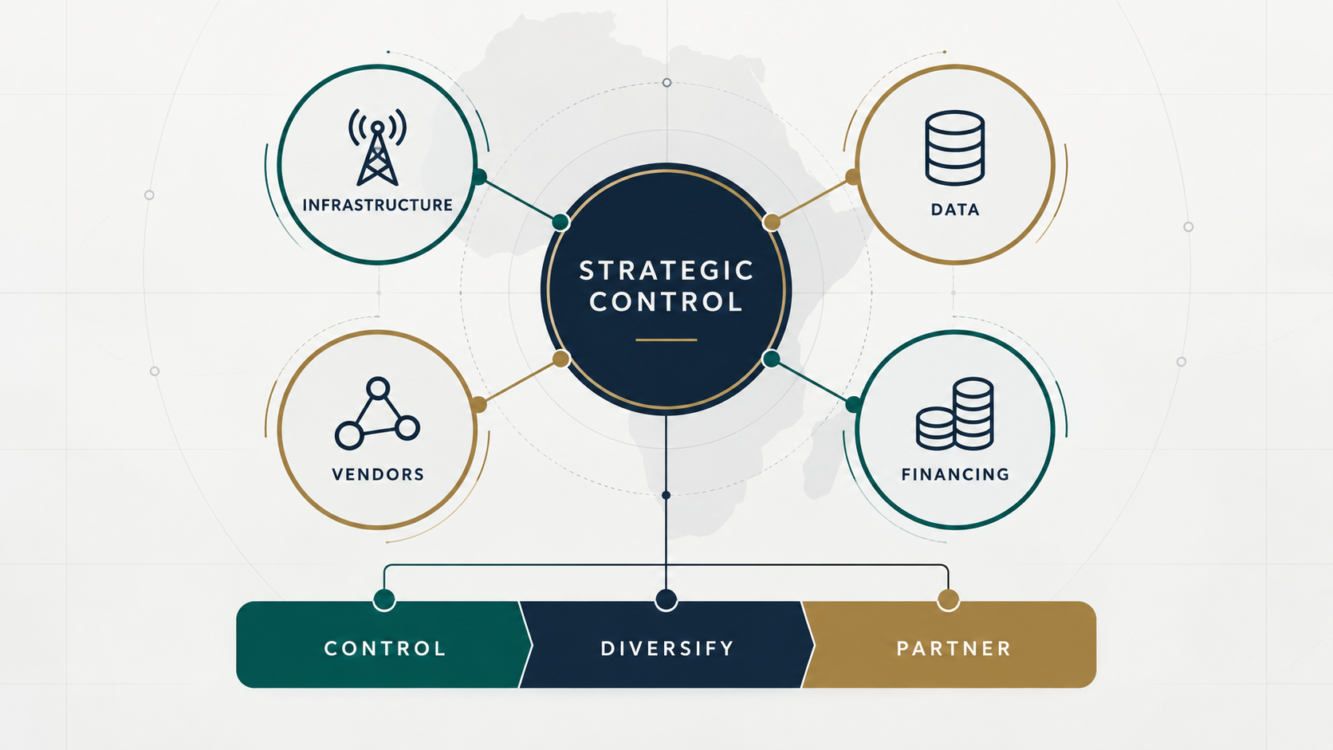
The board needs a consolidated view across four dimensions:
1. Infrastructure
Which physical and digital assets support critical services? Where
are the single points of failure? Can capacity be expanded without
depending on one external ecosystem?
2. Data
Where is sensitive operational or customer data stored and processed?
Which jurisdictions apply? Can the organisation retrieve, move and use
its data if a relationship ends?
3. Vendors
How concentrated is the technology estate? Are interfaces open and
interoperable? Does the organisation possess enough internal capability
to operate, challenge or replace suppliers?
4. Financing
What sourcing, currency, security or policy conditions accompany the
funding? Could a diplomatic or regulatory change alter access to
equipment, updates, support or capital?
This is the point at which vendor management becomes
strategic dependency management.
Strategic sovereignty does not mean owning everything
The language of digital sovereignty can encourage the wrong
conclusion: that countries and companies should build or own every
component themselves.
That approach is neither affordable nor efficient. Africa needs
global capital, technology partnerships and access to world-class
platforms. The objective should be to use those ecosystems without
surrendering the ability to make future choices.
The practical target is strategic optionality—the
capacity to continue a critical service, change direction or negotiate
effectively when circumstances shift.
A useful decision framework has three responses:
- Control capabilities whose failure or external
manipulation would materially threaten the enterprise, such as critical
data, security keys, architecture standards or service-continuity
arrangements. - Diversify dependencies where concentration creates
unacceptable risk, including connectivity routes, cloud regions,
equipment suppliers or implementation partners. - Partner where external scale and specialist
expertise produce superior economics, while preserving contractual
rights, interoperability and exit routes.
The right mix will differ by sector. A bank’s payment infrastructure,
an energy company’s operational technology and a government’s identity
platform will not require identical controls. What matters is that the
choice is explicit rather than accidental.
What this means for Nigerian and African enterprises
The issue extends far beyond telecom operators. Nigerian banks depend
on cloud, payment processors, identity services and cybersecurity
platforms. Energy businesses increasingly rely on industrial sensors,
remote monitoring and vendor-managed software. Manufacturers are placing
finance, procurement and production workflows inside integrated ERP
platforms. Public institutions are digitising citizen services and
national data assets.
At the same time, Africa’s digital infrastructure remains
constrained. Reuters reported in 2025 that the continent accounted for
less than 1% of global data-centre capacity, while mobile data usage was
growing around 40% annually. More recent IMF analysis reported by
Reuters suggested that AI could lift Sub-Saharan Africa’s output by
about 4% over a decade if power, connectivity and skills improve—but the
gain could be negligible without those foundations.
Africa therefore cannot afford to reject investment. It also cannot
afford to adopt infrastructure without understanding the long-term
control implications.
Five actions for executives and boards
1. Map critical services to external dependencies
Start with the services whose disruption would cause the greatest
customer, financial or regulatory harm. Trace every material technology,
data, funding and fourth-party dependency supporting them.
2. Assess total dependency cost
Extend the business case beyond implementation price. Include
switching costs, currency exposure, integration complexity, data
portability, specialist skills and the operational impact of supplier
failure.
3. Define non-negotiable control points
Agree what the organisation must retain: data access, security
credentials, architecture authority, audit rights, configuration
documentation, continuity capability and exit support.
4. Build interoperability before it becomes urgent
Open standards, modular architectures and tested data-export
procedures are easier to establish during procurement than during a
crisis or dispute.
5. Put technology concentration on the board dashboard
Boards should see which critical services depend on a single vendor,
jurisdiction, financing source or technology ecosystem—and whether a
credible alternative exists.
From technology selection to strategic control
The reported Africell financing is an early signal of a broader
reality. As AI, cloud, telecoms, payments and digital public
infrastructure become more economically important, they will attract
more geopolitical competition.
African organisations should welcome credible alternatives and new
sources of capital. But they should evaluate each proposal through a
wider lens: commercial value, resilience, security, interoperability and
future freedom of action.
The board-level question is therefore not merely:
Which technology gives us the strongest capability
today?
It is:
Which combination of control, diversification and partnership
will preserve our ability to compete tomorrow?
How Trimm Solutions can help
Trimm Solutions helps boards and executive teams assess technology
dependencies, redesign operating models, strengthen transformation
governance and connect enterprise architecture decisions to measurable
business outcomes. We support organisations in turning complex
technology investments into resilient, governable capabilities.
Sources
- Reuters
— U.S. administration plans nearly $100 million Africell loan, 11
September 2026 - Reuters
— IFC backs Raxio’s African data-centre expansion, 3 April 2025 - Reuters
— IMF analysis on AI, power and connectivity in Sub-Saharan Africa, 21
July 2026
Share this article
If this perspective could help another executive or organisation, please share it with your network.